Inspiring the next generation: rebuilding construction’s talent pipeline
How can education providers and awarding organisations work together to overcome skills shortages and attract new people to the industry?
16 September 2026
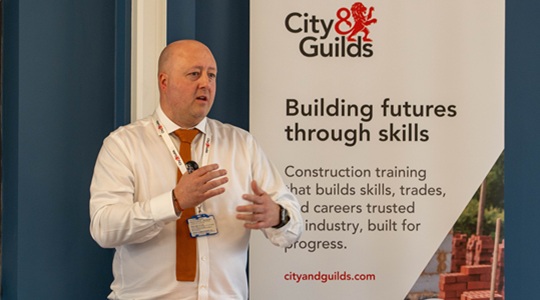
The construction skills shortage is now impossible to ignore. Demand for skilled workers has never been higher yet more people are leaving the sector than joining it. Many young people don’t see construction as a realistic or rewarding career, so there's a challenge to showcase all the opportunities that are available within the industry.
Across colleges, training providers, employers and awarding organisations (AOs), one message rang out clearly at the City & Guilds Construction Conference 2026: inspiring the next generation of construction workers won’t happen by accident. We all have a have a critical role to play in rebuilding the pipeline.
The construction skills shortage needs a shared response
The construction skills shortage is well-documented but the scale of it is still striking. The Energy Security and Net Zero Committee states that the UK needs an estimated 250,000 additional construction workers over the coming years just to meet new housing targets, with thousands more needed for retrofit and net zero commitments. Yet the pipeline of new entrants is struggling to keep up. In turn, this creates a construction skills gap that affects everyone from major housebuilders to local colleges.
Speaking at the conference, Tim Reading, CEO and co-founder, Volunteer It Yourself (VIY) asked: ‘When there’s such a need to build a workforce, and more people are leaving the sector than joining it – how do we make construction more relevant, more rewarding, more accessible for a wider, more diverse mix of young people?’
This is not an issue that can be tackled in isolation. It requires coordinated, cross-sector action which starts with getting more people through the door. Construction simply isn’t on many young people’s radars, and this isn't due to a lack of interest in the industry, but a lack of exposure to it.
"How do we make construction more relevant, more rewarding, more accessible for a wider, more diverse mix of young people?"
Tim Reading, VIY
Helping learners see opportunities in construction
Deliberate, proactive engagement from providers, employers, and awarding organisations working in tandem is needed to reach potential new learners.
Programmes like Volunteer It Yourself’s (VIY) community-based, hands-on projects show how practical, real-life experiences can spark interest in young people. Tim Reading put it simply: ‘There is something about taking construction to young people rather than expecting them to come to construction.’
A recurring theme that came out of the conference was the limited awareness of the variety of roles available within the construction industry. As Cassandra Baxendale from Metaverse Learning said, ‘To inspire the next generation, it has to start with understanding what jobs are out there. We think automatically of bricklaying, but there are thousands of other roles.’
The construction industry is broadening at speed and with a wide range of trades. Today, the industry spans disciplines including digital construction, sustainability roles, planning, surveying, and emerging green technologies.
"To inspire the next generation, it has to start with understanding what jobs are out there."
Cassandra Baxendale, Metaverse Learning
This opens up a real opportunity for colleges and training providers to reposition what they offer. Not just as a route into traditional trades, but as a gateway to careers in construction that are future-focused, technology-driven, and aligned with the things young people genuinely care about. Also speaking at the conference, Sam Delroy Davies, Programme Director at New City College, said construction ‘is something you can be proud of doing and it makes a difference to communities. It inspires young people who are concerned about the climate crisis.’
Supporting clearer career pathways into construction
Awareness alone won’t fill the talent pipeline. Once a young person is interested in construction, they need to be able to see a clear, achievable route forward. Construction career pathways that are well-signposted and accessible from the very beginning are essential and providers have a key role in making them visible.
Routes into construction need to cater for learners at different starting points. The more varied and flexible those entry points, the more learners the sector can reach.
Making first steps achievable for new learners
For many potential learners, the barrier isn’t motivation – it’s access. Short, entry-level qualifications that can be achieved quickly, in familiar community settings, can be the difference between a young person taking that first step and walking away.
VIY’s model demonstrates the power of this approach. An entry level 3 qualification, achievable in as little as three days on site, gives a learner something tangible: a recognised accreditation, a moment of genuine pride, and a platform to build from. As Tim Reading of VIY framed it: ‘Once you get them hooked and they have that fantastic moment of pride at the end of a project, then all things are possible.’
"They also leave with the communication, punctuality, and teamwork skills that employers consistently say are missing."
Matt Mellor, VIY
Matt Mellor, also from VIY, described how young people arrive on their programmes with limited confidence and few formal qualifications, and leave with hands-on skills, a City & Guilds qualification, and a clearer sense of what a construction career could look like. Crucially, they also leave with the communication, punctuality, and teamwork skills that employers consistently say are missing.
Across the conference, one message from providers came through consistently: the City & Guilds name carries genuine weight with learners. ‘The number one thing young people say is that they want to gain a City & Guilds – it’s like the kite mark,’ Tim explained. ‘It gives a very real, achievable thing for young people to aim for, and gives shape and structure to what that introduction to construction looks like.’
For providers, that recognition matters. It supports recruitment, adds credibility to programmes, and gives learners a qualification that employers and the construction industry will recognise and value.
Strengthening progression through clear pathways
Getting learners into construction is only half the challenge. Keeping them there and helping them progress is equally important for long-term construction workforce development.
Construction qualifications that provide structured, work-based progression routes give learners a clear pathway ahead. From an employer perspective, Kathryn Bigelow, Home Builders Federation, cited work and site readiness as a key employer priority. A well-designed qualification pathway builds confidence, links learning to real work experience, and gives employers a meaningful signal of competence.
Luke Mantle, Director of School, Chesterfield College, shared: ‘I see construction as an industry that can really remove barriers, specifically around academic ability. Construction training really gives people an opportunity to get stuck into a different type of training that gives them real opportunity in life.’
Construction apprenticeships remain one of the strongest routes for employer-funded skills development, but supply continues to fall short of demand. Sam Delroy Davies, Programme Director at New City College, described around 800 students competing for just two apprenticeship places. This is linked to the challenge employers face – particularly smaller organisations – who want to take on apprentices but lack the capacity to support them.
Providers, awarding organisations, employers industry bodies and government need to work together to increase the availability of construction training routes at every level.
How can collaboration help tackle the construction skills shortage?
Collaboration in construction training is a necessity. The construction skills gap is too large for any single organisation to solve alone. Collaboration between colleges, training providers, employers, and awarding bodies allows the sector to pool resources, share good practice and reach learners who might otherwise be missed.
Events like the City & Guilds Construction Conference and groups like the City & Guilds Construction Community create space for this kind of joined-up thinking, surfacing shared challenges, creating common language, and opening the door to joint action. Cassandra Baxendale of Metaverse Learning noted: ‘It’s about sharing knowledge and collaborating. We can only do that by working together.’
For learners, that collaboration translates directly into better outcomes: meaningful work experience, stronger employer projects, and a clearer pathway from training to employment.
How City & Guilds supports construction colleges and training providers
City & Guilds works with construction colleges, training providers and employers as a long-term partner, providing the qualifications, frameworks and support that help providers attract learners, deliver high-quality training, and demonstrate real outcomes.
City & Guilds supports providers through:
- Recognised and industry-relevant entry-level and foundation qualifications that offer accessible first steps for new learners
- Structured progression routes which support career progression in the construction industry
- Construction apprenticeships at level 2 and above, including the Level 2 Foundation Apprenticeship in Onsite Trades
- Short courses including Ready For Construction – a three-hour digital course for adults aged 19+
- Events and groups for construction educators and employers
Find out more about City & Guilds construction qualifications and apprenticeships and how we work with providers to support learners at every stage. and how we work with providers to support learners at every stage.
Inspiring the next generation, together
No single organisation can solve the construction skills shortage alone but by working together, the sector can make real progress. Initiatives like the City & Guilds Construction Community and events like the Construction Conference bring providers, employers, AOs and communities around a shared goal, turning conversation into coordinated action.
For providers and AOs, that means acting as educators, connectors, and advocates. By meeting learners where they are and building clearer pathways into the sector, we can begin to rebuild the construction talent pipeline it urgently needs.
City & Guilds has supported construction training providers for decades, bringing together trusted qualifications, sector expertise and a growing community of organisations committed to building a stronger workforce.
Learn more about how we work with the construction industry
Join the City & Guilds Construction Community
The City & Guilds Construction Community provides a dedicated space for this kind of sector-wide collaboration. Open to City & Guilds customers, it brings together training providers, colleges, employers and industry partners to share ideas, discuss challenges, and work collectively on the issues that matter most to the sector.
Join the City & Guilds Construction Community